Members
White Belt Kata
Taikyoku Chudan: the first white belt kata
Taikyoku Chudan is the first kata our white belts learn. The Taikyoku kata were created by Gōgen Yamaguchi Kaiso, the founder of the International Karate-Do Gojū-Kai Association (IKGA), as beginners’ kata (fukyu kata, kata for spreading karate) to practise before Gekisai Dai Ichi and Gekisai Dai Ni.
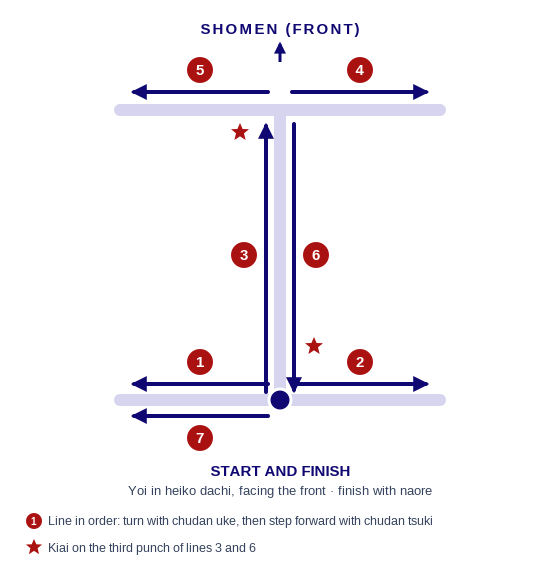
All the Taikyoku kata follow the same simple I-shaped floor pattern (embusen). In Taikyoku Chudan every block is chudan uke (middle block) and every punch is chudan seiken tsuki (middle punch). The kata is performed in zenkutsu dachi (forward stance) throughout. It starts from heiko dachi yoi and ends with naore, back on the spot where you started.
The pattern, line by line
- Yoi: stand in heiko dachi, facing the front.
- Lines 1 and 2: turn to the left with chudan uke, then step forward with chudan tsuki. Turn right around with chudan uke, then step forward with chudan tsuki.
- Line 3: turn to face the front with chudan uke, then step up the centre with three chudan tsuki, with a kiai on the third punch.
- Lines 4 and 5: turn to the right with chudan uke and step forward with chudan tsuki along the top, then turn right around and do the same the other way.
- Line 6: turn to face back towards the start with chudan uke, then step down the centre with three chudan tsuki, arriving back where you began, with a kiai on the third punch.
- Line 7: turn to the left with chudan uke, then step forward with chudan tsuki, along the bottom again.
- Naore: after line 7, return to the starting position.
Every turn starts with a block, and every block is followed by a stepping punch. There is a kiai on the third punch of lines 3 and 6. Your instructor will show you the timing the dojo uses.
Why kata matters
Kata is the heart of traditional karate. Each kata is a set sequence of blocks, strikes, stances and turns against imaginary opponents, handed down from teacher to student over generations. Practising it builds the foundations everything else rests on: strong, stable stances, correct technique, balance, breathing, focus and timing. Because the movements never change, kata gives you an honest mirror. Each time you perform it you can see where your karate has improved, and what still needs work.
Kata also trains the virtues karate is meant to build: patience, discipline, humility and respect. A beginner can learn Taikyoku Chudan in a few lessons, yet senior black belts keep practising simple kata for a lifetime, because there is always more to refine. Studying the applications of kata (bunkai) shows how the movements work against a real opponent, so the techniques you use in kumite and self-defence have their roots in kata. Good karate is built on good kata.